
Many hulusi enthusiasts often sigh: with skilled fingering, precise rhythm, and sheet music memorized by heart, yet when played, it always lacks something.
An expert can tell at once: it lacks an authentic Dai flavor.
The Dai flavor is invisible and intangible, yet it can instantly determine the soul of a piece. Aurally, it is a warm, soft, and mellow timbre, with long, even, and pure breath; deeper still, it is the natural charm nourished by the soil and water of Dai villages, the gentle and refined character accumulated from the ethnic cultural lineage, and the musical echo of the performer empathizing in unison with the local scenery and customs. A Beautiful Place
Combining the consensus of renowned masters such as Gen Dequan, Gong Quanguo, Gong Jiaming, and Zhang Zuyu, the authentic Dai flavor is an aesthetic pyramid that enters the heart through technique and the soul through the heart, rooted layer by layer in the native culture of the Dai people.
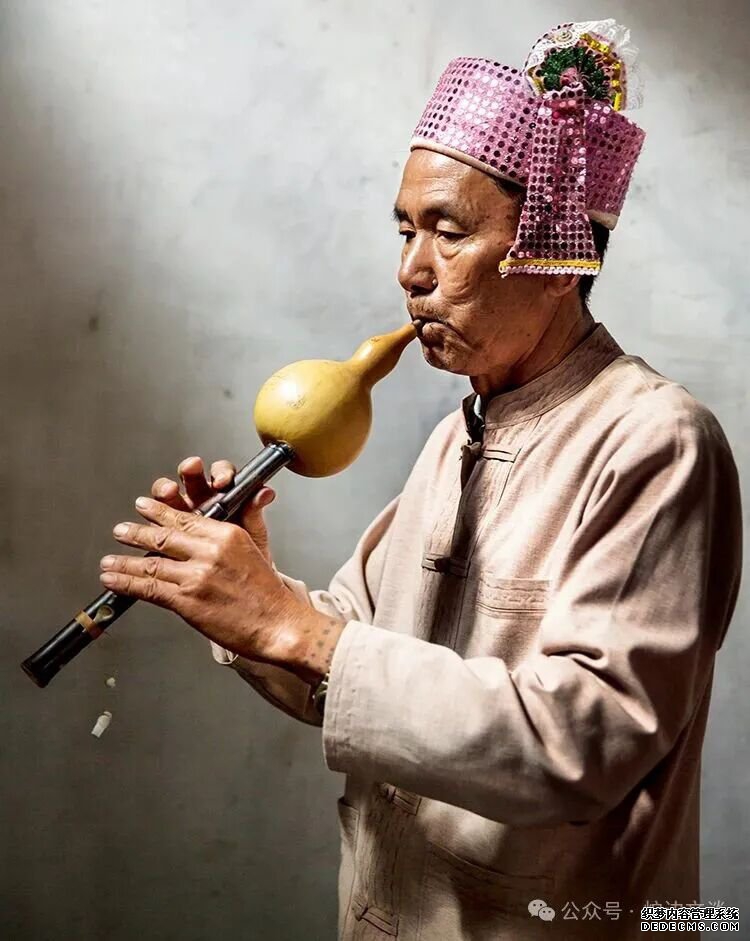
Pictured is Mr. Feng Shaoxing, inheritor of the hulusi and master of original ecological hulusi making.
First Layer: Technique — No Showmanship, Let the Instrument Speak 'Dai'
Many enthusiasts have misconceptions in performance: blindly pursuing forceful blowing, high-pitched sprints, and rapid finger sequences piled up, such as cross-fingering, flutter-fingering, flying fingers, and flutter-tonguing, making the hulusi sound sharp and angular—either like ten thousand horses galloping, or like a suona screeching, or like ghosts wailing and wolves howling. In the end, the more fancy the techniques, the weaker the Dai flavor.
The unanimous consensus among Dai folk artists is: the core of Dai-flavor technique is not competitive showmanship like in a contest, but an original immersive replication of the natural speech rhythm of the Dai language, and a replication of the original ecological singing style of the Dai mountains and fields. Let the instrument shed its stiff playing template and speak the everyday life and smoke and fire of Dai villages.
Senior hulusi artist Gong Jiaming, who has devoted decades to deep cultivation of Dai-flavor folk performance, says that authentic Dai-flavor hulusi does not rely on brute force to press out a full timbre, nor on complicated stunts to attract attention; the vocal line should be soft, gentle, and unhurried, like soft whispers beside a bamboo house, with breath fitting the inherently soft and糯 vocal charm of the Dai language, every sound carrying the smoke and fire of village life, every phrase full of local warmth. In the native living scenes of Dai villages, the hulusi is a folk accompaniment for relieving emotions and connecting with neighbors' friendships; all techniques must serve the native rural accent, and are by no means stiff showmanship that can be taken out alone for display.
Gong Quanguo, one of the folk creators of "Deep in the Bamboo Forest," spent his life rooted in the fields of Dai villages, collecting folk songs and teaching skills, upholding the bottom line of original ecological performance: there are no shortcuts in traditional Dai-flavor fingering; slides,叠音 (stacked tones), staccato, and虚指颤音 (virtual finger vibrato) must be practiced in accordance with the rises and falls of everyday Dai speech tones, and breath must be controlled following the melodic direction of original ecological mountain songs. Finger practice divorced from native speech rhythm, even if proficiency is maxed out, is merely an empty performance shell, and will never produce a trace of authentic Dai village texture. This is also the principle that generations of Dai old craftsmen have upheld: all Dai-flavor-specific techniques are native performance paradigms shaped through repeated polishing over the years, fitting local folk song singing styles, the warm nasal sounds of the Dai language, and the everyday chat tones of village life.
Second Layer: Artistic Conception — Only When the Heart Enters Dai Villages Does the Sound Have Imagery
Solid mastery of traditional techniques is only the entry-level bottom line; if the heart cannot hold the landscapes and customs of Dai villages, the music will never have vivid spirit. The core of advancing the Dai flavor has long transcended the limitations of mechanical performance on a single instrument; it is essentially the performer's deep empathy and two-way fusion with the green mountains and flowing waters, rainforest villages, and folk customs of Dai villages. All standardized fingering, even breath, and standard vibrato must ultimately serve the immersive rural artistic atmosphere.
From the perspective of high-level performance aesthetics, superior authentic Dai flavor has nothing to do with obscure and difficult techniques; it relies entirely on the heart's sincere outpouring and honest recollection of the homeland. Throughout the performance, the mind should be relaxed and expansive, soft and lingering, naturally carrying a warm, gentle rural texture, effortlessly blowing out the warmth of rural streams babbling, the suppleness of rainforest vines stretching, and the elegance of golden peacocks dancing. At this moment, the hulusi is no longer an isolated, cold wind instrument, but a warm bridge connecting the performer with the soil and cultural lineage of Dai villages, allowing every wisp of music to carry the natural vitality of the mountains and fields.
Zhang Zuyu, a senior folk performance master of the Dai ethnic group, who has long traveled to various Dai villages for resident performances, folk song collection, and teaching skills in the countryside, hits the core of practice with his view: the artistic conception of Dai flavor cannot be practiced behind closed doors in a piano room, nor learned from books and sheet music. If the eyes cannot see the vivid outlines of Dai villages' fields, streams, and bamboo houses, the heart cannot accumulate natural and lively charm, and one will absolutely not be able to blow out an authentic Dai flavor full of atmosphere.
Third Layer: Soul — Mastering the Instrument with Emotion, Rhyme through Culture
After layers of铺垫 (groundwork) with proficient and solid technique and vivid, full artistic conception, everything ultimately returns to one core—the word "emotion," which is the ultimate soul of the Dai flavor passed down through the years. The hulusi is inherently a gentle and warm rural folk instrument; it does not win by forceful blowing strength, nor by high, bright notes to catch the eye; its core essence is to establish itself with softness and move people with emotion. Without true emotion, there is no true Dai flavor.
Mr. Gen Dequan's lifelong artistic career is the best model of the soulful expression of the Dai flavor. He deeply cultivated the thousand-year native folk cultural lineage of the Dai ethnic group, thoroughly understood the essence of ancient performance methods passed down from generation to generation, upheld tradition without rigidly adhering to old rules, and innovated reasonably without departing from the roots. In his representative work "Ancient Song," he skillfully used the ancient technique of long-lasting circular breathing, without deliberately creating intense and dramatic melodic ups and downs throughout, but only using long, warm, and gentle silk-like sound to slowly unfold, like an elderly neighbor chatting about old times, softly narrating the thousand-year changes of Dai villages and the everyday life of ancestors. Technique hidden in deep emotion, emotion fused into cultural lineage, not restless or浮 (superficial), warm and heart-touching, he reached the highest realm of Dai-flavor hulusi art in one stroke.
The three native masters Gong Quanguo, Gong Jiaming, and Zhang Zuyu have always upheld the original aspiration of Dai-flavor art and deeply cultivated the inheritance of rural silk music. Gong Quanguo polished classic pieces with full rural warmth, using silk sound to replicate the natural artistic conception of bamboo forest evening breezes and village households by flowing water in Dai villages, establishing a benchmark model of folk Dai flavor; Gong Jiaming deeply cultivated the fusion and innovation of Dai opera accompaniment and hulusi folk music, kneading the warm smoke and fire of village neighbors and native folk sentiments into every melody, firmly guarding the true character of traditional cultural lineage; Zhang Zuyu has long been rooted in grassroots public welfare teaching, not chasing the superficial traffic of the stage, but only upholding "silk sound with emotion, music nourishing the heart," allowing the original authentic Dai flavor to deeply cultivate the countryside and take root among the people. The four masters each fulfilled their roles and worked together to guard the rhyme, jointly protecting the pure artistic soul of the Dai flavor.
Paragraph comments 0 · moderated
Comments 0 · moderated